 Careers
21 Oct, 2026 by Felisa Faith Morales

Before a semiconductor reaches the production line, a network of suppliers and logistics providers is already at work. From specialized components to manufacturing equipment and essential materials, keeping production on track depends on having the right inputs available at the right time.
Yet global sourcing comes with challenges. A 2025 study by the Organisation for Economic Co-operation and Development (OECD) found that semiconductor production is concentrated in certain parts of the world, creating dependencies between countries at different stages of manufacturing. For Philippine manufacturers, delays in the arrival of imported materials, components, or equipment can affect production schedules.
The Philippines’ Growing Semiconductor Trade
The Philippines remains an important participant in the global semiconductor and electronics value chain, particularly in assembly, testing, packaging, and other electronics manufacturing activities.
According to the Semiconductor and Electronics Industries in the Philippines Foundation, Inc. (SEIPI), Philippine electronics imports reached US$31.94 billion in 2025, a 16.67% increase from US$27.38 billion in 2024. Semiconductor components and devices accounted for US$22.22 billion, representing approximately 69.6% of total electronics imports.
China, South Korea, Taiwan, the United States, and Japan were among the country’s leading sources of electronics imports in December 2025, highlighting the international connections that support the industry’s manufacturing and trade activities.
While these imports include products at different stages of the semiconductor value chain, the figures illustrate the scale of cross-border trade associated with the Philippine electronics industry.
For manufacturers, however, securing the necessary components is only part of the equation. Ensuring their timely arrival and availability for production is equally critical.
Strengthening Semiconductor Supply Chains Through Reliable Logistics
In semiconductor manufacturing, even a delayed shipment of components or replacement parts can affect production schedules. Manufacturers need a steady supply of materials and equipment to keep their operations running.
Freight forwarding plays a key role in meeting these requirements. Sea freight handles larger, planned shipments, while air freight is often preferred for high-value components and urgent deliveries that require shorter transit times.
But getting shipments into the country is only part of the process. In the Philippines, imported goods must undergo Bureau of Customs (BOC) procedures, including proper documentation, tariff classification, electronic goods declaration through the Electronic-to-Mobile (E2M) system, and other applicable requirements. Companies operating in Philippine Economic Zone Authority (PEZA) zones must also follow specific importation and documentation procedures.
For companies sourcing materials and equipment from overseas, Royal Cargo provides international sea and air freight forwarding, customs clearance, and brokerage services. Its teams assist with shipment coordination, import documentation, and customs requirements.
For urgent air cargo, TMW Worldwide Express, a Royal Cargo company, provides express customs clearance and bonded warehousing services.
These services help manufacturers manage their regular imports and respond to urgent shipment requirements, particularly when production schedules leave little room for delays.
Looking Ahead to PSECE 2026
For Philippine semiconductor manufacturers, working with overseas suppliers is part of daily business. But getting materials and equipment into the country involves more than arranging shipments. Customs procedures, documentation, and delivery schedules all need to be considered.
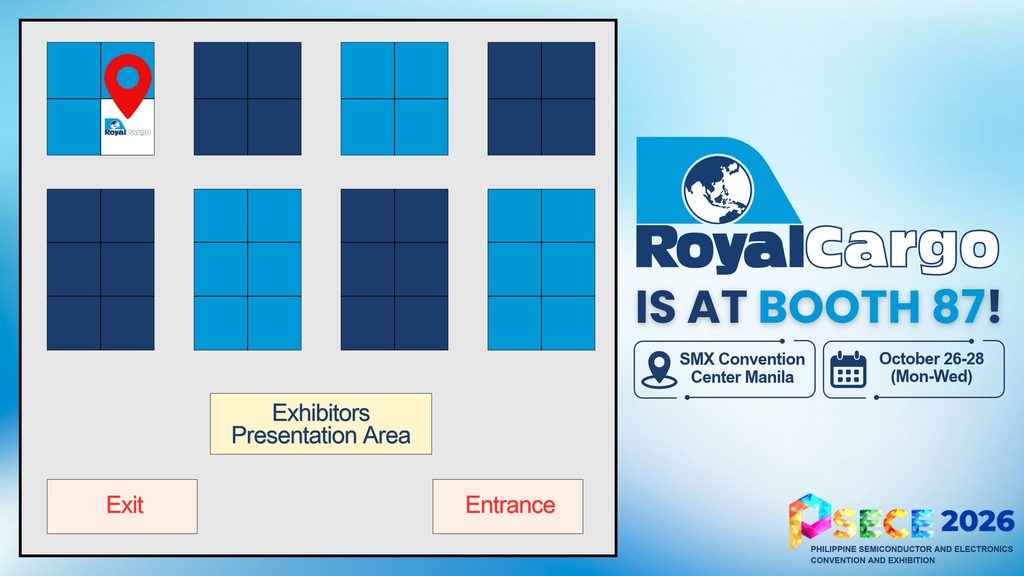
As the industry looks toward new developments and opportunities, the 21st Philippine Semiconductor & Electronics Convention and Exhibition (PSECE 2026) will bring together manufacturers, technology specialists, government representatives, and industry partners on October 26–28, 2026, at the SMX Convention Center Manila in Pasay City.
Royal Cargo will also be participating in the event, presenting its international sea and air freight forwarding, customs clearance, and brokerage services, alongside express customs clearance and bonded warehousing services offered through TMW Worldwide Express.
As the Philippine semiconductor industry continues to strengthen its position in global production networks, reliable logistics and well-coordinated import processes will remain essential to maintaining manufacturing operations and supporting long-term industry growth.


© 2026 Royal Cargo. All Rights Reserved.
General Trading Conditions | Data Privacy Notice